Evidence-Based Intervention for Learning Disabilities: The Gap No One Explains
Evidence-Based Intervention for Learning Disabilities is instruction that is:
-
Backed by research
-
Delivered systematically
-
Measured through data
This is not general tutoring.
This is not extra help.
This is specialized, targeted instruction based on how the brain learns.
According to the International Dyslexia Association, effective instruction must be explicit, systematic, and cumulative.
And the What Works Clearinghouse confirms that intervention must show measurable results to be considered effective.
If progress is unclear, inconsistent, or missing, it is not evidence-based.
The System Gap: Why Schools Struggle With Evidence-Based Intervention for Learning Disabilities
Let’s connect the dots.
Parents are told:
“Your child is getting support.”
“They just need more time.”
“They will catch up.”
Yet… they do not.
This is where the gap lives.
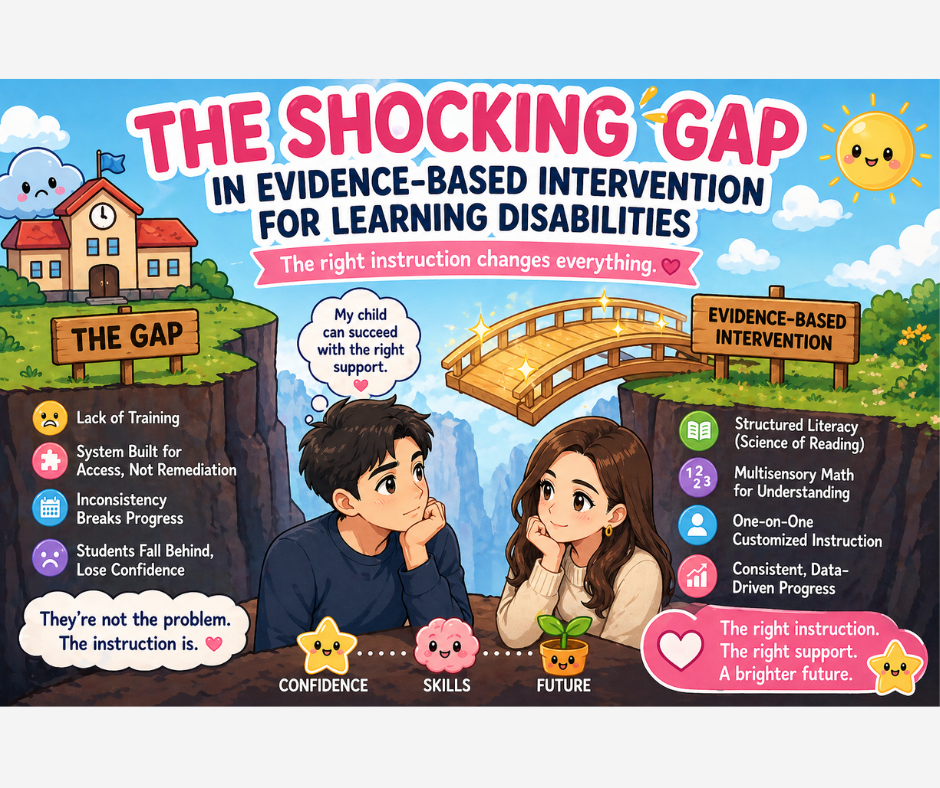
1. Lack of Training in Evidence-Based Intervention
Teachers care deeply.
That is not the issue.
Most teachers are not trained in:
-
Structured literacy
-
Orton-Gillingham instruction
-
Multisensory math instruction
Evidence-Based Intervention for Learning Disabilities requires specialized training, and that training is not standard in most teacher preparation programs. Most teachers recieve less then one full day of instruction of how to teach children how to read.
2. The System Is Built for Access, Not Remediation
Schools are designed to help students access grade-level content.
So they provide:
-
Accommodations
-
Modifications
-
Support services
These are important.
They help students cope.
They do not rebuild foundational skills.
And that is what struggling learners actually need.
3. Inconsistency Breaks Progress
Even when intervention is provided, it is often:
-
Limited in time
-
Delivered in groups
-
Inconsistent week to week
Here is the truth:
Evidence-Based Intervention for Learning Disabilities only works when it is consistent.
Without consistency, skills do not stick.
Structured Literacy: The Standard Behind Evidence-Based Intervention for Learning Disabilities
When it comes to reading, structured literacy is the gold standard.
This includes approaches like Orton-Gillingham, which are rooted in the Science of Reading.
Structured literacy focuses on:
-
Phonological awareness
-
Phonics
-
Fluency
-
Vocabulary
-
Comprehension
It is explicit.
It is systematic.
It builds step by step.
This is not something that can be done casually or occasionally.
If you want to understand how this differs from general tutoring, read this: 👉 https://3dlearningexperts.com/the-surprising-truth-about-tutoring-vs-intervention/
👉 https://3dlearningexperts.com/the-surprising-truth-about-tutoring-vs-intervention/Multisensory Math and Evidence-Based Intervention for Learning Disabilities
Math is often where students fall even further behind.
They are told to:
-
Practice more
-
Memorize facts
-
Try harder
That approach fails students with Dyslexia and Dyscalculia.
Evidence-Based Intervention for Learning Disabilities with math must include multisensory instruction.
This means:
-
Concrete to abstract learning
-
Visual models
-
Hands-on strategies
-
Language-rich instruction
The National Center for Improving Literacy emphasizes explicit instruction across subjects, including math.
Without this, students are just memorizing steps without understanding them.
What Happens When Evidence-Based Intervention for Learning Disabilities Is Missing
This is where families start to feel stuck.
Without Evidence-Based Intervention for Learning Disabilities, students often:
Forget what they just learned Struggle despite hours of effort Lose confidence Develop anxiety around school Start believing they are “not smart”They are not the problem.
The instruction is not aligned with how they learn.
Why Consistency Is Everything
Evidence-Based Intervention for Learning Disabilities requires:
-
Regular sessions
-
A structured plan
-
Repetition with purpose
-
Ongoing progress monitoring
Progress should not feel like a mystery.
You should be able to see it.
Track it.
Trust it.
Here is what that looks like in practice:
How 3D Learning Experts Closes the Gap
This is exactly where most families find relief.
At 3D Learning Experts, we do not rely on guesswork.
We provide Evidence-Based Intervention for Learning Disabilities through:
-
Structured literacy aligned with the Science of Reading
-
Multisensory math for true understanding
-
One-to-one customized instruction
-
Consistent, data-driven sessions
We do not just support students.
We rebuild the skills they were never properly taught.
Final Truth: This Is Bigger Than Tutoring
This is not about more help.
This is about the right help.
Evidence-Based Intervention for Learning Disabilities is the difference between:
-
Coping and progressing
-
Frustration and confidence
-
Falling behind and catching up
When the right instruction is in place, everything changes.
Ready to Understand What Your Child Really Needs?
If you are questioning whether your child is getting the right support, that is worth paying attention to.
Start with clarity.
Because your child does not need more time.
They need the right intervention.