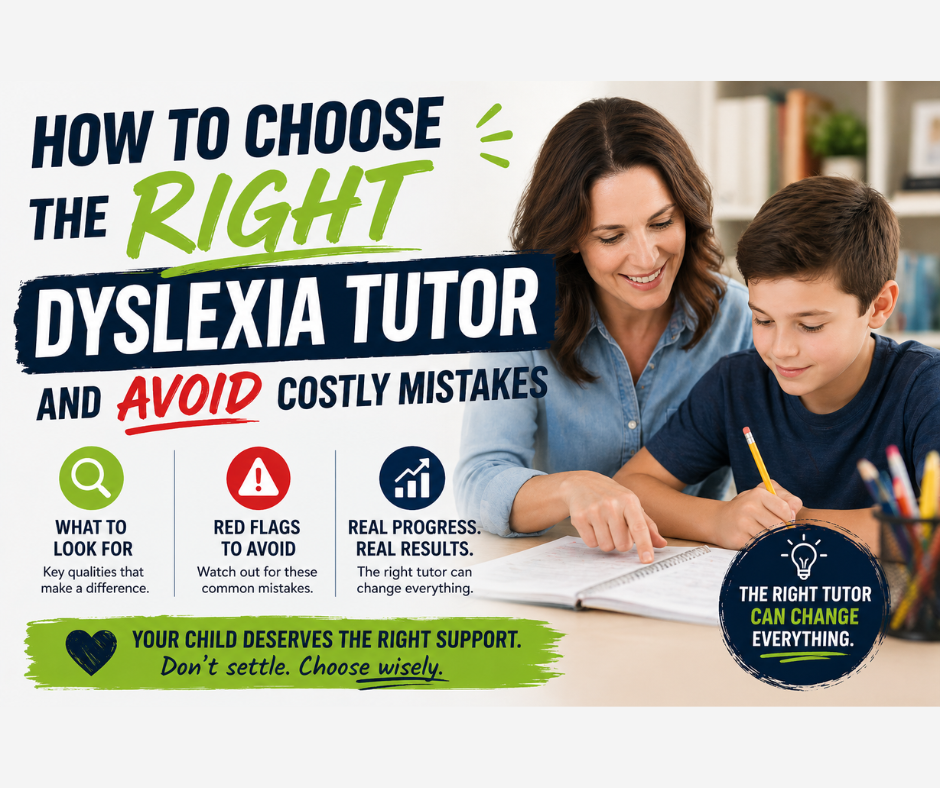
How to choose a tutor for Dyslexia, Dysgraphia, or Dyscalculia is one of the most important decisions you will make for your child.
Most parents are told their child “just needs a tutor.”
That sounds simple.
It is not.
Because the wrong kind of help can keep your child stuck for months or even years.
When you understand how to choose a tutor for Dyslexia, Dysgraphia, or Dyscalculia, you stop guessing and start making decisions that actually move your child forward.
How to Choose a Tutor for Dyslexia, Dysgraphia, or Dyscalculia: Required Training
Not all tutors are trained to work with learning differences.
-
A general tutor may help with homework
 🛑
🛑 -
A classroom teacher may be experienced⚠️
That does not mean they understand how a Dyslexic or Dyscalculic brain learns.
Training and experience matters.
Look for:
-
Orton-Gillingham or structured literacy training
-
Multisensory math strategies for Dyscalculia
-
Explicit, step-by-step writing instruction for Dysgraphia
This is not extra.
This is essential.
At 3D Learning Experts, this is our foundation. Every strategy we use is based on how the brain processes language and math.
👉 Learn more about our approach: https://3DLearningExperts.com/consultWhy the Right Approach Matters (Expert Insight)
This is not just something we believe.
Experts in neurodivergent learning have been saying this for years.
In our interview with Dr. Temple Grandin, she emphasized how critical it is to understand how each child’s brain works and to provide the right kind of support early on. When students are taught in a way that matches how they think, everything changes, from skill development to confidence.
Watch the full conversation here: https://youtu.be/LVran40FZ7g
For additional research on structured literacy, visit the International Dyslexia Association: https://dyslexiaida.org
How to Choose a Tutor for Dyslexia, Dysgraphia, or Dyscalculia: Assessment Expectations (What a Real Evaluation Should Include)
A tutor should never start without understanding your child first.
If there is no assessment, there is no strategy.
When learning how to choose a tutor for Dyslexia, Dysgraphia, or Dyscalculia, you should expect:
-
A comprehensive evaluation
-
Identification of skill gaps, not just grade level
-
A personalized learning plan
This is where many tutoring programs fall short.
They jump into sessions without identifying the root problem.
At 3D Learning Experts, we begin with a full evaluation because guessing is not a plan.
👉 See how we measure growth: https://3DLearningExperts.com/measured-growthHow to Choose a Tutor for Dyslexia, Dysgraphia, or Dyscalculia: Data Tracking That Builds Real Confidence
Progress should not feel like a mystery.
If you are wondering, “Is this working?”
That is already your answer.
When learning how to choose a tutor for Dyslexia, Dysgraphia, or Dyscalculia, data tracking is non-negotiable.
You should expect:
-
Clear baseline data
-
Ongoing progress monitoring
-
Measurable skill growth over time
This is how your child’s confidence is built.
Not by hoping it works.
By seeing real progress, step by step.
At 3D Learning Experts, we track progress so parents can see real, measurable growth.
The Hidden Cost of Choosing the Wrong Tutor
Most parents think the cost of tutoring is financial.
It is not.
The real cost shows up in ways you cannot measure on a receipt.
-
Months or years of lost progress
-
A child who starts to believe they are “not smart”
-
Increased frustration, anxiety, and resistance to learning
-
Paying over and over again for support that does not work
This is what happens when the support does not match how your child learns.
Choosing the right tutor for Dyslexia, Dysgraphia, or Dyscalculia is not just about improvement.
It is about protecting your child’s confidence, time, and future.
Tutoring vs. Intervention: What Most Parents Miss
When learning how to choose a tutor for Dyslexia, Dysgraphia, or Dyscalculia, this is where most parents get stuck.
Not all tutoring is the same.
And understanding this difference can change everything.
|
General Tutoring
|
Specialized Intervention (Like 3D Learning Experts)
|
|
Focuses on homework help
|
Focuses on closing skill gaps
|
|
Follows school curriculum
|
Follows how the brain learns
|
|
Often no formal assessment
|
Starts with a comprehensive evaluation
|
|
Limited or no data tracking
|
Tracks measurable progress over time
|
|
Tutor may not be trained in learning dissbilities
|
Specialists trained in Dyslexia, Dysgraphia, Dyscalculia
|
|
Short-term support
|
Long-term skill building
|
|
Can feel like “more of the same”
|
Feels different because it works
|
If your child has been getting help and still struggling, this is often why.
They did not need more help.
They needed the right kind of help.
How to Choose a Tutor for Dyslexia, Dysgraphia, or Dyscalculia: Parent Communication
How to choose a tutor for Dyslexia, Dysgraphia, or Dyscalculia also means choosing a program that keeps you informed.
You should never feel in the dark.
If your child is working with a tutor and you have no idea what is happening in sessions, that is a red flag.
Strong programs include:
-
Regular parent updates
-
Clear communication about goals and progress
-
Guidance on how to support your child at home
Parents are part of the process.
Not an afterthought.
At 3D Learning Experts, we believe empowered parents create successful students.
How to Choose a Tutor for Dyslexia, Dysgraphia, or Dyscalculia: Red Flags to Watch For
When learning how to choose a tutor for Dyslexia, Dysgraphia, or Dyscalculia, knowing what to avoid matters.
Trust your instincts.
If something feels off, it usually is.
Watch for these red flags:
🚩“We just help with homework”🚩 No structured program or curriculum🚩 No progress tracking🚩 No specialization in Dyslexia, Dysgraphia, or Dyscalculia🚩 Quick fixes or guarantees🚩 Your child is still frustrated after months of help🚩 These are not small issues.
🚩 They are signs your child is not getting what they actually need.
The Truth About How to Choose a Tutor for Dyslexia, Dysgraphia, or Dyscalculia
Your child does not need more help.
Your child needs the right kind of help.
There is the difference between:
-
Struggling and progressing
-
Frustration and confidence
-
Falling behind and finally moving forward
When you understand how to choose a tutor for Dyslexia, Dysgraphia, or Dyscalculia, everything changes.
Ready to Find the Right Support for Your Child?
At 3D Learning Experts, we specialize in working with students who learn differently.
This is not general tutoring.
This is targeted, evidence-based intervention designed for real results.
✔️ Personalized learning plans✔️ Trained specialists in Dyslexia, Dysgraphia, and Dyscalculia✔️ Measurable progress tracking✔️ Ongoing parent support✔️ You do not have to figure this out alone.
👉 Schedule your free consultation here: https://3DLearningExperts.com/consultFAQ
• What qualifications should a Dyslexia tutor have?
A Dyslexia tutor should be trained in structured literacy approaches such as Orton-Gillingham or EBLI and understand how to teach reading based on how the brain processes language.
• How do I know if tutoring is working?
You should see measurable progress through data tracking, improved skills, and increased confidence over time.
• What is the difference between tutoring and intervention?
Tutoring often supports classroom work, while intervention targets the root cause of learning challenges using specialized methods.
• How long does it take to see results?
With the right approach, many students begin showing measurable progress within months, depending on consistency and individual needs.