
Twenty-six familiar letters. One overlooked foundation. A different way to understand children who struggle to write.
An eight-year-old boy who struggled with writing did something remarkable.
He decided to write a note to his teacher.
Nobody assigned it. Nobody insisted.
He wanted to surprise her.
For most children, this might seem ordinary. For this boy, whom I’ll call Blair, it represented something much bigger.
Despite a year of occupational therapy and two years of special education support, writing remained a significant struggle.
Yet after a day and a half of exploring the alphabet differently, he was choosing to put pencil to paper.
Not because someone told him to.
Because he had something he wanted to say.
What changed?
I believe the answer may be hiding in plain sight.
The alphabet itself.
Knowing the Alphabet Isn’t the Same as Being Able to Use It
Most of us assume children learn the alphabet in kindergarten.
They sing the ABC song. They recognize letters. They learn to read.
The alphabet? Check that box.
But what if recognizing or reciting the alphabet doesn’t mean a child can reliably retrieve, organize, and produce those same letters?
Imagine being handed 26 tools. You recognize them all, but when you need one, you can’t always find it or remember how it fits.
Now imagine managing those tools while thinking about spelling, punctuation, and what you want to communicate.
That’s a lot to ask of a developing learner.
Recognizing the alphabet is not the same as being able to use it.
Before assuming a child needs more handwriting practice, shouldn’t we investigate whether the foundation is secure?
The Question That Changed My Life
I didn’t set out to challenge assumptions about alphabet learning.
I was a tax lawyer raising an exceptionally bright son who loved reading and conversation but struggled with handwriting and spelling.
Even teachers who adored him wondered whether he was lazy or obstinate.
By Grade 5, he’d stopped cooperating with schoolwork.
As his mother, I knew there had to be more to the story than a lack of effort.
My search led me to train in various literacy learning modalities, earn a master’s degree, and eventually develop Alphabetter™, my own approach to learning.
It also led me to a question that has guided nearly 30 years of my work.
What if the struggling learner isn’t the problem? What if we’re overlooking something about how learning has taken place?
Introducing Alphabet Coherence
I’ve worked with children, teenagers, and adults whose struggles with written language often stand in sharp contrast to their intelligence and creativity.
Some have been diagnosed with dysgraphia or dyslexia. Others have been labeled inattentive, careless, unmotivated, or lazy.
I’ve become interested in how securely learners have integrated the 26 letters of the English alphabet.
I call this Alphabet Coherence.
It’s a way of examining how reliably someone can recognize, organize, retrieve, and produce alphabet symbols.
Can they produce letters independently? Distinguish uppercase and lowercase forms? Understand letter orientation and spatial relationships?
And what happens emotionally when they’re asked to perform these tasks?
Do they hesitate, become frustrated, lose focus, or avoid the task?
To explore these questions, I developed the Hidden Genius Literacy Assessment (HGLA), a tool designed to reveal aspects of alphabet learning that may otherwise go unnoticed.
It isn’t a diagnostic test for dysgraphia or a replacement for comprehensive professional evaluation. Writing difficulties are complex, with potential contributions from motor coordination, language processing, memory, and other factors.
Alphabet Coherence is a framework developed through my work with learners, not a single explanation for every writing difficulty.
My invitation is simple:
Before we ask a child to try harder, let’s make sure we’ve understood what makes the task hard.
Twenty-Two Letters and a Surprising Breakthrough
When asked to produce both upper and lower case alphabets independently, Blair generated only 22 alphabet symbols in total, not all of which belonged to English.
Despite years of support, his ability to produce the symbols required for writing remained incomplete.
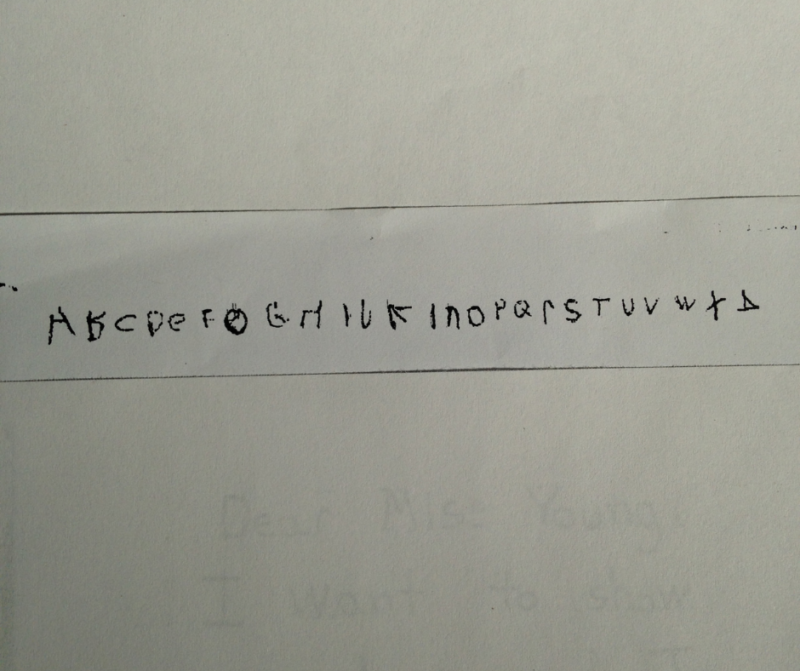
Instead of beginning with more handwriting worksheets, he returned to the alphabet.
Through playful, multisensory experiences, Blair explored letter shapes, sequences, movement, and spatial relationships.
Within a day and a half, dramatic improvements in his printing and his ability to produce uppercase and lowercase letters were clear.
But the most important moment wasn’t about handwriting.
It was his decision to write that note to his teacher.
He wanted to communicate. He wanted to create a surprise.
He wanted to write.
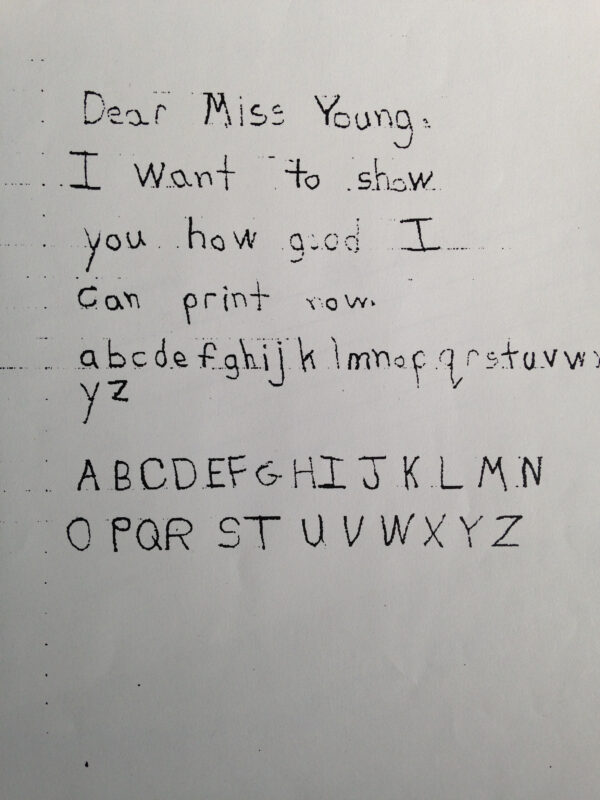
One child’s experience cannot establish what will work for everyone or how long improvements will last. But Blair’s experience illustrates why investigating alphabet foundations may reveal possibilities that additional handwriting practice alone could miss.
What If Learning Felt More Like Discovery?
When I developed Alphabetter™, I wanted to move beyond repeating unsuccessful exercises until something finally sticks.
I wanted learning to involve curiosity, movement, play, and discovery.
Learners construct letters with clay, exploring their shapes and relationships.
In the Alphabet Mix-up Game, partners rearrange each other’s letters, then explain how to restore the correct sequence without touching them.
They’re observing, reasoning, communicating, remembering, and collaborating.
Other activities incorporate rhythm, movement, and challenges such as reciting the alphabet backward.
When they succeed they join the KNAB Club: Knows Alphabet Backwards.
Yes, learning can include a little fun.
The goal isn’t to make the alphabet harder. It’s to make learning it more meaningful, memorable, and engaging.
The contribution of individual activities to literacy outcomes warrants further research. What I’ve witnessed is the difference when learners participate with curiosity instead of dread.
The Story a Struggling Learner Starts to Believe
When children struggle with something classmates seem to accomplish easily, the problem doesn’t always stay on the page.
It can become a story they tell themselves.
I’m slow.
I’m stupid.
Something is wrong with me.
I can’t learn.
Those beliefs can linger for decades.
One 19-year-old young woman asked me a question I’ve never forgotten.
“Is it possible that some people just can’t learn?”
Imagine being 19 and wondering whether that’s true about you.
After experiencing dramatic improvement in her printing, she said something different.
“I feel that I can learn anything now.”
Her handwriting had improved.
But something else had shifted, too.
The story she believed about herself.
Another learner, a 77-year-old man who’d been forced to write with his non-dominant hand as a child, had spent much of his life believing he was stupid.
After our work together, he told me several times:
“I woke up laughing again today.”
Literacy difficulties aren’t merely academic concerns.
They can shape how people see themselves, what they attempt, and what they believe is possible.
Sometimes, a breakthrough in writing becomes a breakthrough in confidence.
The Brain Has to Trust Learning
I often say, “The brain has to trust learning.”
For me, that means creating experiences where learners feel safe to experiment, make mistakes, discover patterns, and experience success.
It means becoming curious before becoming critical.
It means recognizing that apparent resistance may reflect frustration or fear of another unsuccessful experience.
It also means inviting parents, siblings, and grandparents to become partners in discovery rather than observers of another frustrating homework session.
When we change the experience of learning, we may change how someone feels about participating in it.
Twenty-Six Letters. A Much Bigger Possibility.
The alphabet is one of the first things we teach children.
It’s also something we rarely question once they can recite it.
We assume the foundation is secure.
But what if it isn’t?
What if some learners are working harder than we realize because accessing familiar symbols requires more effort than anyone has noticed?
These questions inspired Project 111K, my initiative to invite 111,000 people to explore their Alphabet Coherence and become curious about how early alphabet learning may relate to their experiences with written language.
Not because the alphabet explains every literacy difficulty.
It doesn’t.
But because we shouldn’t overlook a foundation simply because we’ve assumed it was mastered.
If you’re a parent, educator, or adult who has struggled with written language, I invite you to explore Alphabet Coherence and the questions it raises.
Twenty-six letters.
So familiar we rarely question how we’ve learned them.
Yet important enough to deserve another look.
I think about Blair, the eight-year-old who struggled for so long.
And the moment he picked up his pencil to write his teacher a note.
Not because someone demanded another attempt.
Because he had something he wanted to say.
What if more struggling learners could experience that kind of possibility?
That’s a question worth exploring and a conversation worth having.
_________________________________________________________________________________________________

Diane Devenyi, JD, MEd, founded The Learning Force, created Alphabetter™ and the Hidden Genius Literacy Assessment, and wrote Dear Genius. For nearly 30 years, she has helped children, adults, and families explore new possibilities for literacy, confidence, and learning.
Learn more: alphabetter.ca
_________________________________________________________________________________________________
Editor’s Note: Diane Devenyi, JD, MEd, was a featured guest on The Empowered Parent Podcast, formerly known as The Learning Disabilities Experts Podcast. We are delighted to welcome her back as a guest contributor, sharing her insights and experience in helping struggling learners build literacy skills and confidence.
Want to learn more about Diane’s approach to literacy and the power of understanding how children learn? Watch her two-part interview with Jess Arce:
🎙️ Part 1: Part 1: How Does Dysgraphia Affect Writing? Harness the Hidden Power in Your ABCs
🎙️ Part 2: Part 2: Teaching the Alphabet in a Fun Way: How to Make the Alphabet with Clay