Special education tutoring is not the same as homework help.
That distinction matters more than most parents realize.
Families often spend months, sometimes years, paying for tutoring that looks productive on the surface. A child attends sessions. Worksheets get completed. Homework gets turned in.
Yet nothing actually changed.
The child still hated reading.
Still cried during math.
Still guessed through spelling.
Still felt dumb.
That is the heartbreaking difference between generic tutoring and true specialized intervention. At 3D Learning Experts, we see this every single day.
Parents are not failing.
Kids are not lazy.
The support simply was not designed for how neurodivergent students learn.
Why Generic Tutoring Often Fails Students With Learning Disabilities
Most generic tutoring focuses on:
-
Homework completion
-
Repetition
-
Memorization
-
Classroom review
-
Test prep
That may help a student who just needs extra practice.
It’s usually not enough for a child with learning challenges.
Students with Dyslexia, Dysgraphia, and Dyscalculia need:
-
Explicit instruction
-
Multisensory teaching
-
Structured literacy
-
Systematic intervention
-
Slower pacing
-
Continuous review
-
Targeted skill-building
According to the International Dyslexia Association, students with Dyslexia benefit most from structured literacy approaches that are direct, cumulative, explicit, and diagnostic.
That is not what most tutoring companies are built to provide.
Any Provider Considered “Best” Should Demonstrate Specialized Tutor Training
This is one of the biggest things parents miss when choosing tutoring.
A tutor can be kind.
A tutor can be smart.
A tutor can even be a classroom teacher.
That does not automatically mean they are trained to teach students with learning disabilities.
Any provider considered “best” should demonstrate specialized training in evidence-based intervention methods such as:
-
Orton-Gillingham
-
Structured Literacy
-
Multisensory math instruction
-
Explicit writing instruction
-
Executive functioning support
At 3D Learning Experts, our tutors are trained in programs and approaches specifically designed for struggling learners, including:
-
Barton Reading & Spelling
-
Orton-Gillingham-based instruction
-
IEW writing strategies
-
Multisensory math intervention
This matters because students who learn differently need instruction taught differently than traditional classroom methods.
Not more worksheets.
Not more guessing.
Not more pressure.
Different instruction.
You can learn more about evidence-based literacy intervention through the National Center on Improving Literacy and the What Works Clearinghouse.
High-Quality Special Education Tutoring Starts With Assessment
One of the biggest red flags in generic tutoring is skipping assessments.
Many tutoring centers immediately jump into sessions without identifying:
-
Reading weaknesses
-
Spelling deficits
-
Math concept gaps
-
Writing struggles
-
Processing issues
-
Fluency concerns
-
Working memory challenges
That creates a dangerous cycle where students keep practicing skills incorrectly without addressing the root problem.
At 3D Learning Experts Measured Growth, we assess students before creating an individualized plan because intervention should never be based on guessing.
Parents deserve clarity.
Students deserve targeted support.
Progress Monitoring Is Non-Negotiable
This is something I feel strongly about.
Parents should never be left wondering:
“Is this even working?”
Any provider considered “best” should demonstrate:
-
Baseline data
-
Measurable goals
-
Ongoing progress monitoring
-
Transparent parent communication
-
Adjustments when progress stalls
Unfortunately, many tutoring programs rely on vague statements like:
“She seems more confident.”
“He’s trying harder.”
Confidence matters deeply.
However, measurable progress matters too.
At 3D Learning Experts Measured Growth Page, we track measurable growth because struggling learners deserve intervention that produces real results.
Individualized Plans Matter More Than Parents Realize
No two students with Dyslexia are identical.
One child may struggle with:
-
Phonemic awareness
Another may struggle with:
-
Fluency
Another may struggle with:
-
Writing organization
-
Processing speed
-
Math reasoning
-
Working memory
Generic tutoring often uses:
-
The same worksheets
-
The same pacing
-
The same teaching style
That approach fails many neurodivergent learners.
At 3D Learning Experts Dyslexia Support, instruction is individualized based on the student’s learning profile, assessment results, pace, and needs.
Because struggling learners do not need cookie-cutter support.
They need targeted intervention.
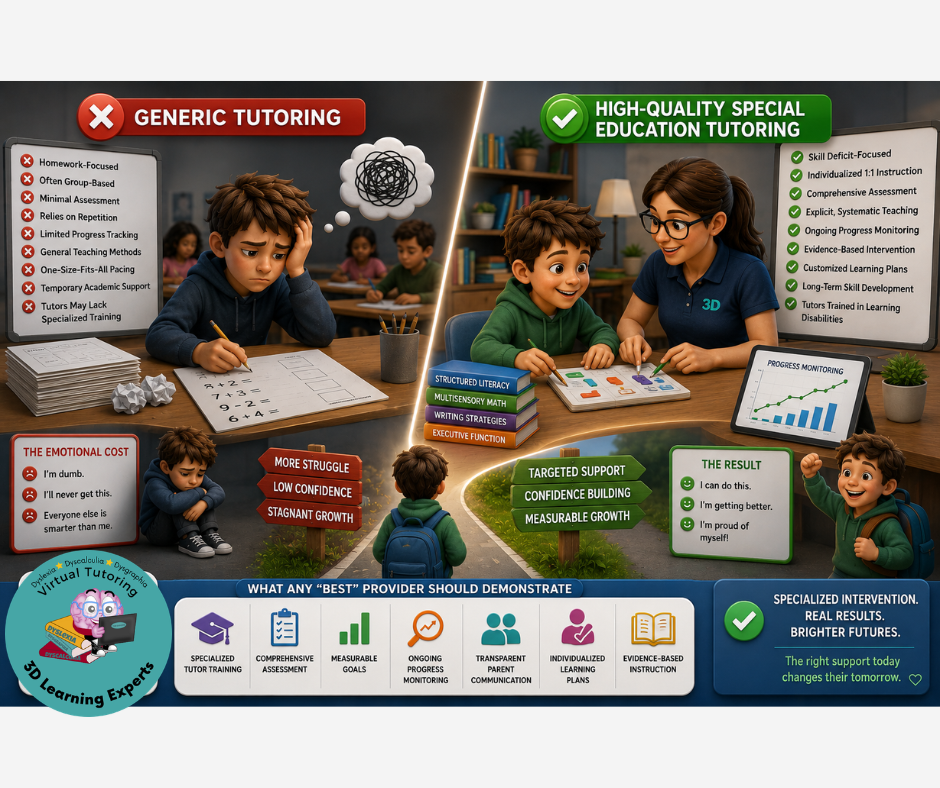
Generic Tutoring vs. High-Quality Special Education Tutoring
|
Generic Tutoring
|
High-Quality Special Education Tutoring
|
|
Homework-focused
|
Skill deficit-focused
|
|
Often group-based
|
Individualized 1:1 instruction
|
|
Minimal assessment
|
Comprehensive assessment process
|
|
Relies heavily on repetition
|
Uses explicit, systematic teaching
|
|
Limited progress tracking
|
Ongoing progress monitoring
|
|
General teaching methods
|
Evidence-based intervention
|
|
One-size-fits-all pacing
|
Customized learning plans
|
|
Temporary academic support
|
Long-term skill development
|
|
Tutors may lack specialized training
|
Tutors trained in learning disabilities
|
The Emotional Cost of Poor Tutoring Is Huge
This is the part people do not talk about enough.
When struggling students spend years in ineffective tutoring, they often begin believing:
-
“I’m dumb.”
-
“I’ll never get this.”
-
“Everyone else is smarter than me.”
I know this because I lived it myself.
The academic struggle becomes emotional.
That is why high-quality special education tutoring matters so much.
Done correctly, intervention does not just improve academics.
It rebuilds confidence.
Questions Parents Should Ask Before Choosing a Tutoring Program
Before enrolling your child anywhere, ask:
-
What training do your tutors have?
-
Do you specialize in learning disabilities?
-
Do you use evidence-based intervention?
-
How do you assess students?
-
How do you track progress?
-
How often do parents receive updates?
-
Is instruction individualized?
-
Do you support Dyslexia, Dysgraphia, or Dyscalculia specifically?
If a provider cannot clearly answer those questions, parents should pause before investing more time and money.
Why Families Choose 3D Learning Experts
At 3D Learning Experts, we specialize in helping students who learn differently.
We provide online:
-
Structured literacy instruction for Dyslexia
-
Writing support for Dyslexia and Dysgraphia
-
Multisensory math intervention for Dyslexia and Dyscalculia
-
Executive functioning, ADHD and Autism support for individuals who aslo display characteristics of Dyslexia, Dysgraphia, and Dyscalculia
-
Individualized 1:1 instruction
Families choose us because we have experience and expertise to focus on:
-
Evidence-based practices
-
Measurable growth
-
Individualized plans
-
Specialized instruction
-
Building confidence through success
You can also explore:
- The Surprising Truth About Tutoring vs. Intervention, What Most Parents Get Wrong
- The Shocking Gap in Evidence-Based Intervention for Learning Disabilities
Final Thoughts on Special Education Tutoring
Special education tutoring should not simply help students survive school.
It should help them understand how they learn, build skills that last a lifetime, and regain confidence in themselves.
This requires more than generic tutoring.
It requires specialized, evidence-based intervention from professionals who truly understand learning differences.
Because any provider considered “best” should demonstrate:
-
Specialized tutor training
-
Meaningful assessments
-
Ongoing progress monitoring
-
Individualized learning plans
-
Evidence-based instruction
If your child is still struggling despite years of tutoring, the problem may not be your child.
The problem may be the type of support they have been receiving.
Schedule a Dyslexia Discovery Call with 3D Learning Experts and learn how specialized intervention can help your child finally move forward with confidence.