
When parents hear the words summer break, they often picture sleeping in, swimming, vacations, and taking a break from school.
And they should.
Children absolutely need time to rest, play, and recharge.
What they don’t need is to stop learning completely.
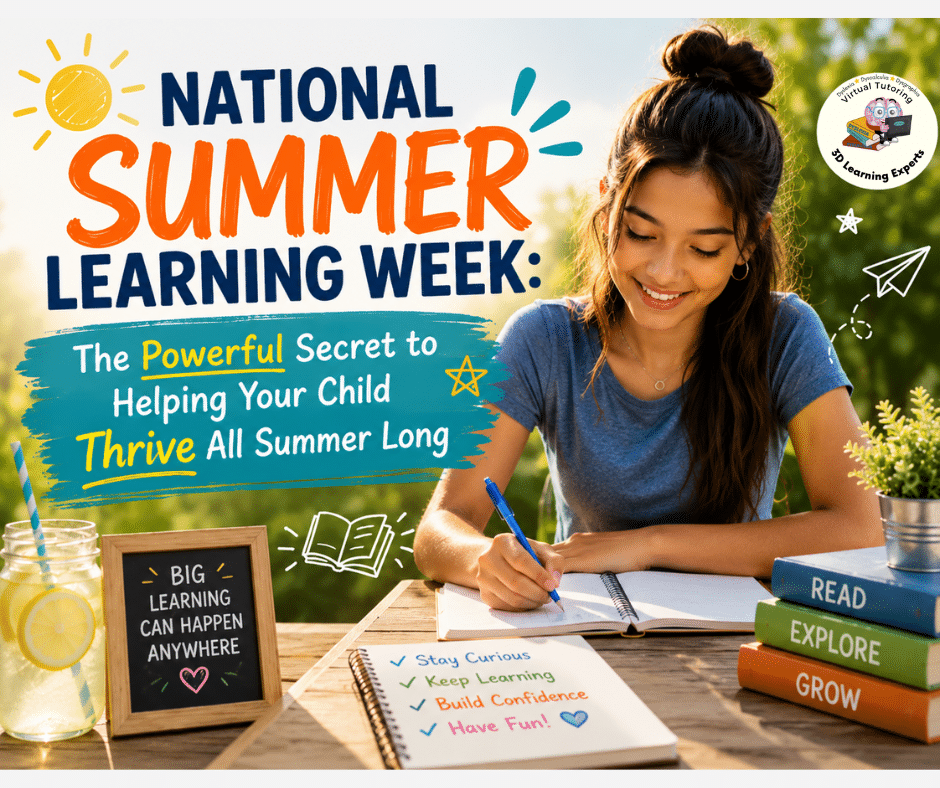
That is exactly why National Summer Learning Week exists. This week, I want to highlight the importance of keeping my children engaged in meaningful learning experiences all summer long so they return to school confident, prepared, and ready to succeed.
As someone who struggled with Dyslexia growing up, I know firsthand what happens when learning stops.
Summer wasn’t a break for me.
It was time to forget skills I had fought so hard to learn.
For many children, especially those with Dyslexia, Dysgraphia, Dyscalculia, and similar language-based learning difficulties, the summer months can either become a setback or an incredible opportunity.
The difference often comes down to what families choose to do.
Why National Summer Learning Week Matters
During the school year, children spend hours each day practicing reading, writing, math, and problem-solving.
Over the summer, those skills can begin to fade without regular practice.
Researchers have found that high-quality summer learning opportunities help students maintain academic skills and return to school better prepared for success. National Summer Learning Week shines a spotlight on the importance of making summer engaging, educational, and fun.
The good news?
Learning doesn’t have to look like school.
In fact, it ‘s better if it doesn’t! Say no to those summer workbooks.
Fun Summer Learning Ideas Your Child Will Actually Enjoy
One of the biggest misconceptions parents have is that learning means worksheets.
It doesn’t.
Children learn best when they’re curious, engaged, and having fun.
Here are some of my favorite ways to sneak learning into everyday summer activities.
Read Together, take turns reading pages.
Listen to audiobooks.
Read recipes.
Read maps.
Read menus.
Read comic books.
Every word counts.
If your child struggles with reading, don’t force long sessions. Short, successful reading experiences build confidence far better than frustrating ones.
Practice Real-Life Math
Math is everywhere.
Have your child:
-
Calculate restaurant tips
-
Keep score during games
-
Budget vacation spending money
-
Compare prices in stores
-
Measure furniture for a room makeover
This builds true mathematical thinking instead of memorization alone.
Turn Cooking Into a Math Lesson
The kitchen is one of the best classrooms you’ll ever have.
Ask your child to:
-
Measure ingredients
-
Double a recipe
-
Cut recipes in half
-
Estimate cooking times
-
Compare prices while grocery shopping
They’re practicing fractions, multiplication, estimation, and problem solving without realizing they’re doing math.
Visit Your Local Library
Libraries are summer learning gold mines.
Many offer:
-
Reading challenges
-
STEM activities
-
Craft days
-
Guest speakers
-
Book clubs
-
Free educational events
Your child gets to explore new interests while developing literacy skills.
Keep a Summer Adventure Journal
Instead of asking, “What did you do today?”
Ask your child to write or draw one memorable moment every evening.
Younger children can dictate while you write.
Older students can practice complete sentences, descriptive writing, and storytelling.
Bonus points if they include pictures.
Explore Nature
Go outside.
Collect leaves.
Identify birds.
Measure plants.
Track weather.
Take pictures of insects.
Draw pictures of what you see in your own backyard.
Ask questions.
Curiosity is the foundation of learning.
Build Something
LEGO creations.
Cardboard forts.
Birdhouses.
Marble runs.
Simple engineering challenges build:
-
Planning
-
Problem solving
-
Spatial reasoning
-
Creativity
-
Executive functioning
Let Your Child Teach You
One of my favorite activities is asking children to become the teacher.
Have them explain:
-
How volcanoes work
-
Their favorite animal
-
Space
-
Dinosaurs
-
Baseball statistics
-
Minecraft strategies
Teaching strengthens learning.
Keep Learning Short and Consistent
Here’s something many parents find surprising.
You don’t need hours every day.
Twenty to thirty minutes of intentional learning several days each week often makes a much bigger impact than cramming everything into one long session.
Consistency wins.
Always.
When Summer Tutoring Makes Sense
Some children simply need more support.
If your child has Dyslexia, Dysgraphia, Dyscalculia, or another language-based learning difference, summer can be the perfect time to strengthen foundational skills.
Without homework, state testing, and packed school schedules, students often make remarkable progress because they can focus on learning without the daily pressure of the classroom.
I have watched students walk into summer avoiding reading and return to school volunteering confident and ready to read.
Not because summer magically fixed everything.
Because they finally had uninterrupted time to build the skills they needed.
At 3D Learning Experts, we provide one-on-one virtual intervention using structured, multisensory instruction for students with Dyslexia, Dysgraphia, Dyscalculia, and similar learning challenges. Our summer sessions are personalized to each child’s needs.
If you’re wondering whether your child could benefit from targeted intervention, you can learn more on our Reading & Spelling, Writing and Math pages, or schedule a Free Discovery Call to discuss your child’s unique needs.
National Summer Learning Week Is Just the Beginning
I don’t believe children need a summer full of worksheets.
I believe they need a summer full of experiences.
Read together.
Explore together.
Cook together.
Build together.
Ask questions together.
Laugh together.
Those moments create memories.
They also create stronger readers, better problem solvers, more confident learners, and children who walk into the new school year believing they can succeed.
And sometimes, that’s the most important lesson of all.
Ready to Keep the Learning Going?
If your child struggles with reading, writing, or math, summer is one of the best times to build lasting skills before school begins again.
Learn more about our programs at: