
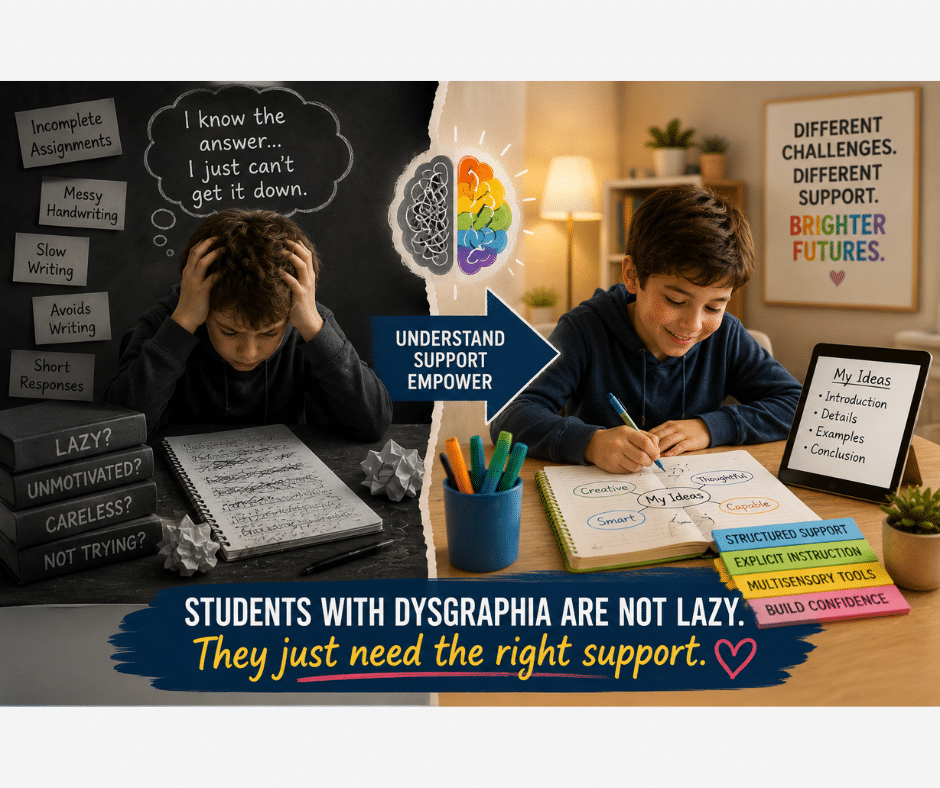
Students With Dysgraphia are some of the most misunderstood students in schools, today.
I cannot tell you how many parents have sat across from me in tears saying:
“They can explain everything out loud.”
“They are so smart.”
“Why does writing completely fall apart?”
Then the school labels the child as lazy, unmotivated, careless, or inattentive.
That is the dangerous mistake.
Students with Dysgraphia are often fighting an invisible neurological struggle every single time they are asked to write.
At 3D Learning Experts, we work with students every day who have incredible ideas, strong verbal skills, and deep intelligence, yet completely shut down when writing enters the picture.
And sadly, many schools still do not fully understand what Dysgraphia actually is.
What Is Dysgraphia?
According to the International Dyslexia Association, Dysgraphia is a neurological learning disability that impacts written expression and the physical act of writing.
However, Dysgraphia is far more than messy handwriting.
That is one of the biggest myths schools continue to believe.
Students with Dysgraphia may struggle with:
-
Organizing thoughts on paper
-
Spelling while writing
-
Sentence structure
-
Grammar
-
Writing stamina
-
Letter formation
-
Spacing
-
Working memory
-
Written expression
-
Getting ideas from the brain onto paper
Some students struggle more with handwriting and fine motor skills then others.
Others struggle primarily with written expression disorder and language organization.
Many struggle with both.
Why Students With Dysgraphia Can Explain Answers Verbally Yet Cannot Write Them
This is one of the biggest signs parents notice.
A child may verbally give an incredible answer.
Then they write one incomplete sentence.
Or nothing at all.
Why?
Because writing places enormous demands on working memory.
Students with Dysgraphia are often trying to manage:
-
Letter formation
-
Spelling
-
Grammar
-
Sentence structure
-
Punctuation
-
Organization
-
Fine motor control
-
Remembering the original idea
All at the same time.
That cognitive overload is exhausting.
Research from the National Center for Learning Disabilities explains that students with learning disabilities often experience breakdowns in executive functioning and working memory that directly impact written output.
This is why working memory and writing difficulties are so closely connected.
The child may absolutely know the answer.
They simply cannot efficiently transfer it onto paper.
The Dangerous Assumption Schools Often Make
Too often, schools see:
-
Incomplete assignments
-
Avoidance
-
Short responses
-
Messy handwriting
-
Slow writing speed
-
Refusal to write
And they assume:
-
Laziness
-
Lack of effort
-
Behavioral problems
-
Poor attention
-
Lack of motivation
That misunderstanding damages students with Dysgraphia emotionally and academically.
I have worked with students who started believing:
-
“I’m dumb.”
-
“I hate school.”
-
“I’ll never be good at writing.”
-
“Why try?”
Meanwhile, these same students may be incredibly verbal, creative, insightful, and intelligent.
The emotional impact of academic frustration and Dysgraphia is massive.
Dysgraphia Is Not Just Handwriting
Another major misunderstanding is assuming Dysgraphia only affects handwriting.
Yes, handwriting and Dysgraphia can absolutely overlap.
However, many students with Dysgraphia struggle more with written expression than actual penmanship.
They may:
-
Forget what they wanted to say mid sentence
-
Lose track of ideas
-
Struggle organizing paragraphs
-
Write extremely simplified responses
-
Avoid detail
-
Shut down during essays
-
Experience severe writing fatigue
This is why traditional writing instruction often fails students with Dysgraphia.
Most classrooms focus on:
-
Writing volume
-
Speed
-
Independent output
-
Repetitive worksheets
-
Minimal explicit instruction
That approach overwhelms students whose brains process writing differently.
Why Traditional Writing Instruction Often Fails
Many schools teach writing assuming students naturally develop written organization skills through repetition.
Students with Dysgraphia usually do not.
They need:
-
Explicit instruction
-
Structured writing intervention
-
Step-by-step modeling
-
Multisensory writing instruction
-
Reduced cognitive overload
-
Direct feedback
-
Scaffolded support
-
Assessment-driven intervention
Simply telling a child to “write more” rarely solves the problem.
In fact, it often increases school avoidance and anxiety.
What Effective Dysgraphia Intervention Actually Looks Like
Effective support for students with Dysgraphia must be individualized.
At 3D Learning Experts’ Dysgraphia Support Programs, we focus on identifying the root cause of the writing struggle first.
That matters because not every student struggles for the same reason.
Strong Dysgraphia intervention includes:
-
Comprehensive assessment
-
Structured writing instruction
-
Multisensory writing intervention
-
Explicit teaching of sentence and paragraph structure
-
Working memory support strategies
-
Assistive technology when appropriate
-
Gradual skill building
-
Confidence rebuilding
-
Accommodations paired with remediation
The Emotional Cost of Ignoring Dysgraphia
This is the part schools often underestimate.
Writing struggles in children do not stay academic.
They become emotional.
Students with Dysgraphia often experience:
-
Anxiety
-
Shame
-
Avoidance
-
Perfectionism
-
Learned helplessness
-
Low self-esteem
-
School refusal
When a child repeatedly feels incapable of showing what they know, confidence starts collapsing.
I have seen brilliant students completely disengage from learning because nobody recognized the true problem underneath the writing struggle.
What Parents Should Look For
If your child:
-
Avoids writing
-
Complains of hand pain
-
Writes extremely little
-
Has strong verbal skills yet weak written work
-
Melts down during writing assignments
-
Forgets ideas while writing
-
Struggles organizing thoughts
-
Has inconsistent spelling
-
Becomes exhausted after short writing tasks
It may be time to explore a written expression disorder evaluation.
Early identification matters.
The longer students with Dysgraphia go without proper intervention, the larger the academic gap often becomes.
Why Specialized Online Tutoring for Dysgraphia Can Help
Many families turn to generic tutoring and quickly discover it is not enough.
Homework help is not the same as intervention.
Students with Dysgraphia need specialized, structured support designed for how their brains learn.
At 3D Learning Experts, our online tutoring for Dysgraphia focuses on:
-
Individualized instruction
-
Multisensory writing instruction
-
Explicit writing strategies
-
Confidence building
-
Assessment-driven intervention
-
Executive functioning support
-
Structured writing systems
We meet students where they are while helping them rebuild both skills and confidence.
You can also explore:
Final Thoughts About Students With Dysgraphia
Students with Dysgraphia are not lazy.
They are not unintelligent.
They are not broken.
They are students whose brains process writing differently.
And when schools misunderstand those struggles, students pay the emotional price.
The good news is this:
With proper intervention, structured writing instruction, and individualized support, these students can absolutely grow into capable, confident writers.
Sometimes they simply need someone who finally understands what is really happening underneath the struggle.
Ready To Get Help?
If your child is struggling with writing, avoidance, written expression, or academic frustration related to Dysgraphia, schedule a consultation with 3D Learning Experts.
You do not have to navigate this alone.